
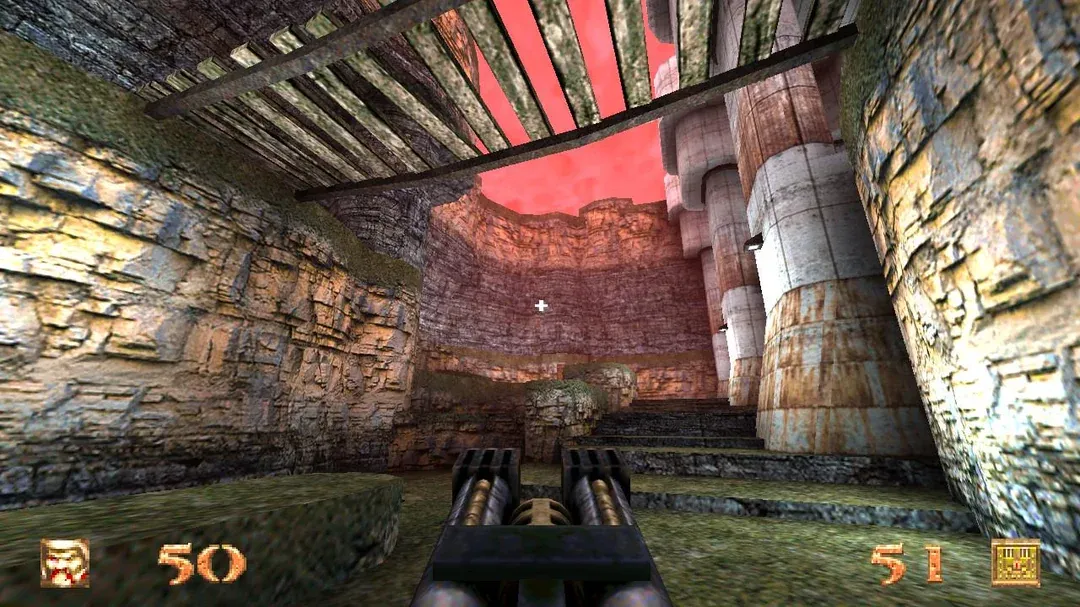
This summer is the 30th anniversary of Id Software's ground-breaking 3D shooter Quake. I didn't realize it was the 30th anniversary, but I knew reflexively it came out in the summer. Why? Because it was the summer I spent entirely indoors, first building a PC capable of playing it at higher resolution – and then working my way through the levels, all while Trent Reznor's score thumped through the Creative Labs desk speakers. My vitamin D was very, very low that year.
This isn't about my personal journey with the game (though – humblebrag – I did play through it a second time on "nightmare" difficulty), but rather the profound impact that gaming has had on technological progress. Spacewar!, a game built in university computer labs, drew in students who otherwise had no knowledge or interest in computers. People bought the first home computers because they'd played Pong in a bar and wanted it in their living room. The home PC revolution was ushered in by games, computers that played arcade classics but could extend to other uses. Over the years, people bought sound cards and faster processors — and later, dedicated GPUs — to run games that demanded them. Quake is an inflection point in that story. Its release pushed PCs toward real 3D hardware and native Internet-based multiplayer. By extension, it accelerated the rise of a whole host of technologies and uses: high-speed connectivity and online discussions. And the demand for game-grade graphics turned the GPU from rarefied gamer gear into standard equipment — then scaled it into the workhorse behind crypto mining and, later, AI training. The future arrived that summer I spent indoors, unleashed in a flood of radiant polygons.
A Box Only a Spreadsheet Could Love
The history of games and the history of computers are deeply intertwined. While the first "digital" computers were focused on military applications like codebreaking in World War II and missile trajectories in the Cold War, as they became more general-purpose, one of those purposes became games. And the passion to make those games better drove improvements in hardware and operating systems. It's what led to Pong as well as the first home PCs.
By the early 1990s, though, that momentum had stalled on the PC. The serious games were on Nintendo and Sega consoles, machines built from the ground up for gaming graphics, motion sprites, and sound. The PC, meanwhile, had found its calling in the office: it was the machine that ran your spreadsheet, balanced your books, and printed your reports. Games were a sideshow – if they existed at all. It was, in the view of most game creators, a box only a spreadsheet could love.
But that verdict confused what the PC lacked with what it couldn't do. It wasn't that PCs of that era were incapable of serving as gaming platforms – it required equipment they didn't have natively, like sound and graphics cards, and graphics tools that the operating system (DOS) didn't provide. What was happening – what was being driven by those spreadsheet programs – was a doubling of processor power and more and more memory. That was the raw material to create a 3D game engine.
It had something else as well: networking capabilities. When PCs took over offices, it ushered in the age of networked computers. This was the period when client-server computing took hold – PCs as clients and a server for file storage and printing. Those networks meant PCs could connect to each other as well, and not just for spreadsheets but...for games.
Client-Server via a Demonic Mars
A bit of 3D gaming and the publisher's history are useful for understanding Quake's story. Id Software was founded in 1991 by four people who had left a larger game publisher. Led by "the Johns" – Carmack, who handled engineering, and John Romero, who handled game design and visuals – they focused on PCs as their platform. They had recognized that PCs were popping up everywhere. Home use was becoming more prevalent for adults and kids. It was in the early 90s that Microsoft changed its tagline from "A computer on every desk" to "A computer on every desk, and in every home."
Released in 1993, Doom was Id's breakout — its first mega-selling game. It deserves a post in its own right if for nothing else than it has become the de facto hardware tester ("yes, but will it run Doom?"). The game was the first generation of what John Carmack called idTech – a rendering engine that coaxed 3D gameplay from machines without dedicated graphics capabilities. It also brought with it the ability for four PCs running Doom to play against one another in the same game. That was a revolution in gaming, where multiplayer to date had been two people side-by-side in front of the same screen. Now everyone had their own screen and could see the game from their POV while playing with their friends (or coworkers after hours, for example).
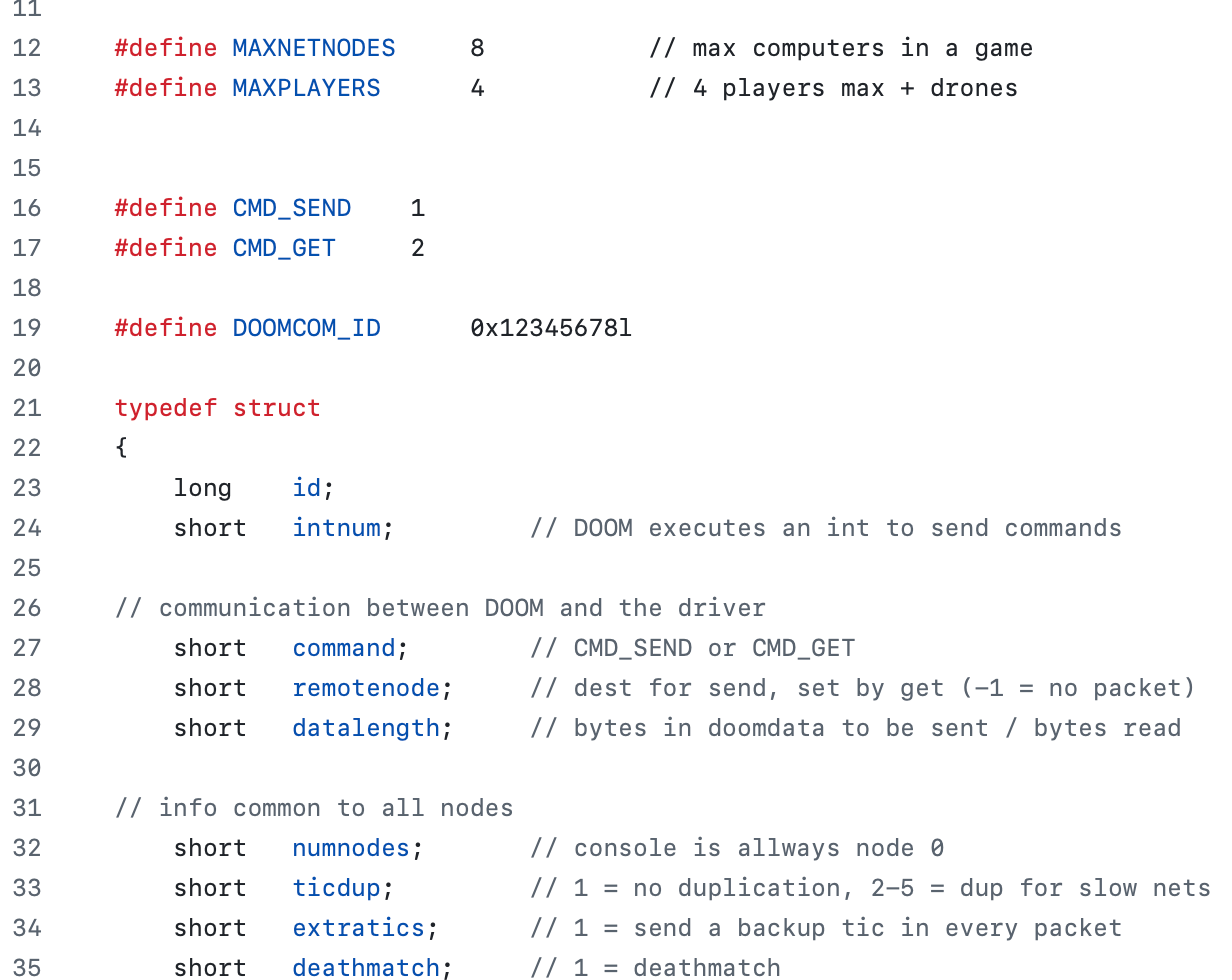
Quake vastly improved on that multiplayer compatibility in groundbreaking ways: It became a true client-server implementation, allowing for dedicated game servers – first on local networks and then over the Internet. It boosted the number of concurrent players to 16. And it adapted to the speed of the network link, letting faster connections take advantage of improved gameplay. Combined, these changes allowed people to either create their own parties to play Quake or find players across the Internet.
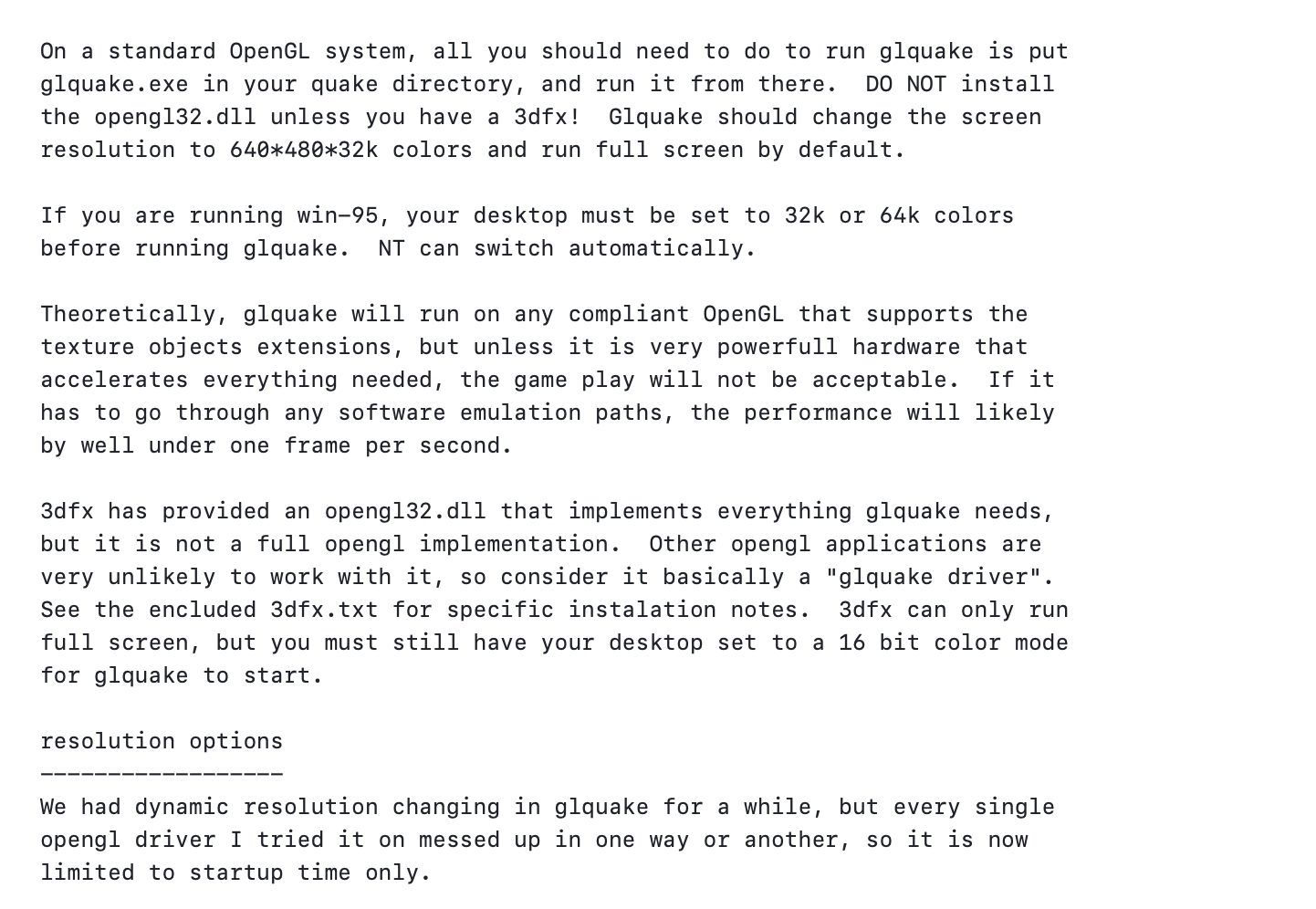
Quake was also the first true 3D first-person shooter engine for PCs. Doom cheated a bit on 3D: sprites (characters) always faced front, aiming and shooting were on one plane, and the weapon could not be pointed independently of the player. And – crucially for the future – Doom did not take advantage of the nascent graphics cards found in a small number of PCs. Quake (as GLQuake) was the first 3D engine to use OpenGL, a standard started in 1991 to provide a common way to render vector graphics that was understood by the early generations of graphics cards. This, and other improvements, meant that Quake could do things with more degrees of movement and aiming, shadow effects, being able to see characters from any side, higher frame rates and resolution. It made gaming more immersive. And – if you saw people play the game with higher-end graphics or with people over the Internet – you wanted that, too, and would run out to buy and build (as I did that summer) the machine it required.
Simulated Ripples in a Polygon Pool
The difference in experience between playing Quake on a standard PC (good) and one with higher-end graphics capabilities, processor, and RAM (mind-blowing) was stark. Processors and RAM were standard, though more expensive upgrades. At the time of its release, there were a few options for graphics cards, with the leading models being Voodoo and Riva.
The maker of Riva was a small chip startup named Nvidia. The company was struggling in 1996, having laid off 60 of its 100 employees. They had a small lifeline through an agreement with Sega to develop graphics chips for their upcoming console, Dreamcast, but it was a challenging environment for specialty chip manufacturers. The big market was PCs, but there wasn't much appetite for specialty graphics cards, since none of the popular software at the time used them.
Until Quake came along.
The launch of Quake was the moment when graphics cards went from a niche product creating chips for arcades or – if they were lucky enough – dedicated gaming consoles to widespread consumer adoption. The embrace of OpenGL meant any chipset that leveraged it (or its more focused version, MiniGL) would unlock the incredible visuals lurking in the game engine. This demand for graphics cards is what made Nvidia. Riding the wave Quake created, Nvidia's Riva card sold 1M units in the first four months of its release in 1997. Nvidia found its market and would eventually absorb 3dfx. The skill in creating custom chipsets for high-end math calculations (which is, at root, what 3D graphics is) positioned them to supply hardware for the next "new thing" of the new millennium: cryptocurrency. And then to supply the chips perfect for training Large Language Models. There's no Claude without Quake.
Open Source and Rocket Jumps
The hardware was only part of Quake's influence. The other impact was on software developers — and a habit that turned out to be just as consequential.
Readers will also note that I've added images of the Doom and Quake source code in the paragraphs above. Those are small examples of something Id Software did that was wholly unique at the time: once a game engine had outlived its commercial life, they released its source code to the public. Wolfenstein's code went out in 1995, Doom's in 1997, Quake's in 1999 — eventually all under the GPL, the same license as Linux.
This mattered for two reasons. The first was cultural. Open-source software already existed — Linux is the famous example — but it was largely the province of people willing to spend a weekend writing a mouse driver. Id's releases drew in a very different crowd: people who had no interest in operating systems but would happily lose a hundred hours refining a rendering engine to make a better game. It was a gateway drug to the whole movement. Many of the engineers now maintaining the open-source foundations of our modern world — the software behind the Internet, Android, and databases — were first drawn into those communities by wandering through a dark maze with Nine Inch Nails as the soundtrack.
That is the other long-tail revolution. The graphics cards made Quake look amazing and spawned generations of advanced hardware; open-sourcing the engine created a legion of software engineers to use that hardware to build incredible new things.
The Inheritance of Quake
Gaming has changed significantly in the three decades since Quake's release. PC gaming exists, and even the cheapest machines have advanced graphics capabilities. The launch of the iPhone and Android phones shortly after gave rise to an entirely new platform in mobile gaming. And, while the hardware and experience are still clunky, the next gaming frontier is virtual reality. Quake is arguably the progenitor of all of these platforms. More importantly, the game spurred innovation and investment in specialty chipsets from users demanding the best experience. Chipsets that powered the highest resolution and cinematic frame rates for Quake evolved into something else.
The future often arrives via curious means. Codebreaking brought us the first digital computers. The need for resilient communication networks capable of surviving a nuclear weapons exchange gave rise to the packet-switching technologies that power the Internet. The two most transformative technologies of the last decade – cryptocurrency and LLM-based AI – were ushered in by that Lovecraft-inspired 3D shooter.

Member discussion: