
“Shai-Hulud defends his treasure.” – Dune: The Machine Crusade
An Intelligence Simulation
Artificial Intelligence has long been a quest to understand the functions of the human brain, to unlock the mysteries of how it works, and to replicate those processes in silicon. From the Eliza project at MIT in the 1960s to today’s frontier LLM models, we’ve become very adept at simulating some of what we think of as human intelligence. Where Eliza would walk a very basic decision tree to simulate a human therapist: “Why do you think that?” Large Language Models (“LLMs”), trained on vast datasets, are much better at giving detailed answers and providing at times eerily lifelike answers, but the mechanism is really just a much more sophisticated Eliza: “What is the best next response based on my training?” It’s not really “creative” or “empathetic” but instead breaks down the request into its elements and provides the highest rated response from its data. It is a "sentence continuation machine" at its core.
This is why we see LLMs excel at tasks like coding, research, and analysis against set frameworks, because much of that work is pattern recognition. There’s usually a right or subset of better answers out of a range of possibilities. You want AI to apply Porter’s Five Forces Model to a set of facts you give it? The training set knows how similar facts were interpreted and extrapolates to the scenario you provide? You want AI to build an integration to Google Maps using TypeScript? That, too, is in the training set.
This mirrors how we train humans for these roles. If you study software engineering, you learn the best way to build data structures, what conditional logic to apply based on input, how to create a user record. Modern LLMs are great at this because they’ve seen millions of code snippets, know what the consensus “right” answer is, and apply that. It’s pattern recognition for the best solution at a massive scale. The kind of applied intelligence that we train people to do across professions.
But LLMs aren’t reasoning. They can’t update from new information or stimuli in the way we would expect a generally intelligent system to behave, the kind of intelligence we would refer to as Artificial General Intelligence. With AGI, “training” would move from ingesting existing data to the AI system “experiencing” and learning from those interactions. We’re not there yet. LLMs have fixed “weights” from the humans designing that drive their chain-of-thought, next-best-answer kind of output.
General intelligence is not unique to humans – we observe this kind of learning through stimuli, through experiences in all animals, even worms. So, if we observe this self-learning in animals, why wouldn’t we try to emulate the biological mechanisms that underlie this capacity? That’s what the OpenWorm project is all about.
The Open Worm Project
Copying a human brain is still a fantasy technology – we’re a long way from recording consciousness into ROM constructs like Neuromancer. But, we do have the ability to map more simple organisms, and with the expectation that unlocking the understanding of how they work will lead us to understand human cognition and forge a perfect simile in silicon.
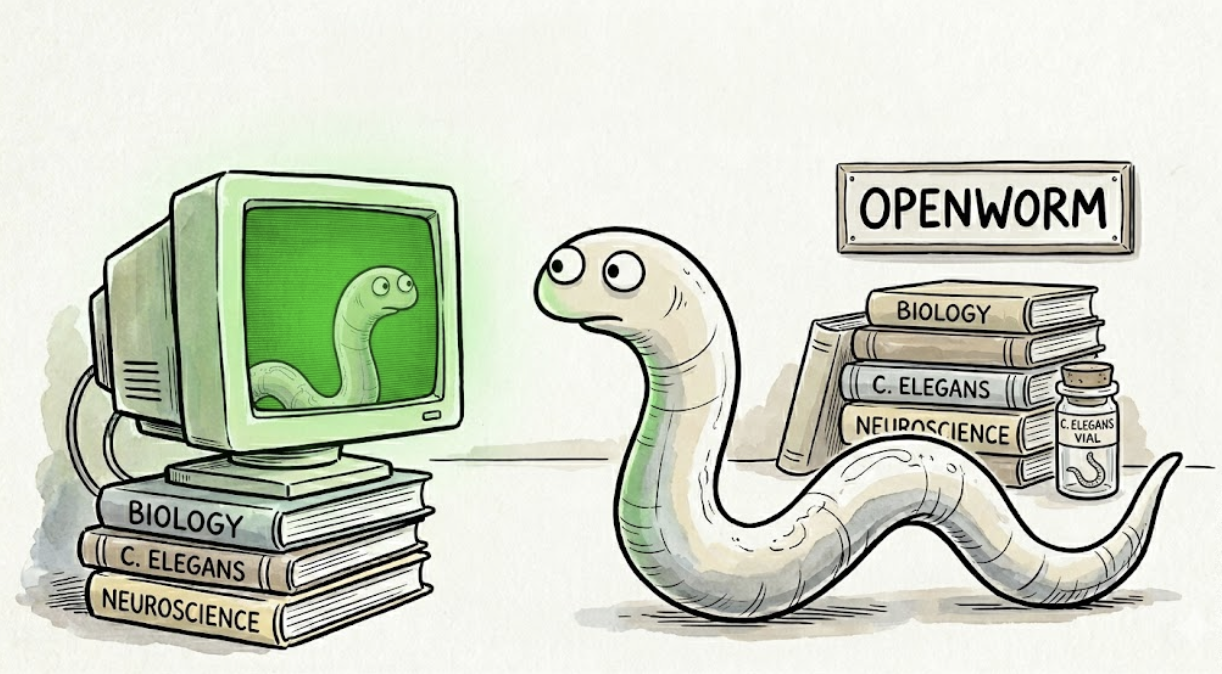
The OpenWorm Project (www.openworm.org) began in 2011 to do exactly that. It follows the premise that the best way to create intelligent machines is to copy the biological systems that exhibit learning, adaptation, and creativity. OpenWorm uses a nematode called Caenorhabditis elegans as this foundational first step. About 1mm in length, C. elegans is a very simple creature with just 302 neurons. Capable of learning from its environment, including foraging for food, navigating by its senses, and escape, it’s a starter kit for generalized intelligence.
C. elegans is also one of the few organisms to have its “connectome” (array of neurons and synaptic connections) completely mapped, which is why it is the basis for OpenWorm – there’s a complete blueprint of its brain. They’ve turned that blueprint into downloadable code so people can create their own digital worm that behaves like a real one. This has long been an article of faith in artificial intelligence research that if we could faithfully replicate the “wetware” we could recreate the same capabilities in silicon.
OpenWorm is fascinating as an open-source science project. There’s a 3D model of the worm, including its digestive and nervous systems. There are videos showing live worms moving through their environment. And, of course, you can download via GitHub the code for the worm's connectome. Armed with all of this knowledge, spinning up a clew of pixelated nematodes must be routine. Maybe (since this is the typical test of new platforms) worms are playing Doom.
Actually…no.
Despite having a complete view of the machinery for how the worm thinks, we still can’t create a digital copy that does more than wiggle. Locomotion, yes; cognition, not yet.
There are many things we know about the way neurons work in animals that suggest we’re still missing key information to replicate their learning behavior: We don’t know which neurons are active or suppressed given certain stimuli, we don’t know how molecules like neuropeptides released by an organism create a feedback loop in the body. So, while we have a facsimile of the wiring, we don’t know how the signals are generated or how the connections are used. There’s tremendous value in the research, both for neurobiology and data science, but it also shows the limits in our understanding of how intelligence actually works.
The Slalom Course to AGI
The tools from platform AI companies, approaching consumer-brand levels of public awareness, and Large Language Models are woven into everyday life: ChatGPT as a therapist, Gemini as a meme creator, and Claude for organizing files. These interactions can be spooky – the LLM communicates and does things in a way that seems almost human. Models will undoubtedly get better at chain of thought, at the kind of pattern matching and solutions that we marvel at today. But that’s not AGI. The AI is not really learning, and can’t take on new tasks that exist outside of its training set.
There is some debate in data science circles as to whether Large Language Models can ever evolve into something that exhibits AGI. The platform companies – who are certainly biased – talk about it being imminent. AI researchers like Yann LeCun argue that the design of LLMs has a built-in ceiling. Useful at all the tasks it’s trained on, but not a truly adaptive intelligence that humans (or worms) have. He argues in part that LLMs don’t have world models or grounding in experiences. They don’t have sensory stimuli from their environment. We also don’t understand the mechanism of how that learning, that problem-solving of novel tasks, works in animal intelligence.
LLMs may help us with the research, the hidden patterns of how animal intelligence works, but they are likely not on the direct path to AGI. It seems very likely that we cannot get there until we understand how learning works in animals, whether they have cilia or opposable thumbs. One day, the worm will give up its secrets, and we’ll have more of the map to replicate human intelligence in the machine.
Further reading:
Yann LeCun’s Brown University lecture: https://www.brown.edu/news/2026-04-01/yann-lecun-artificial-intelligence-pioneer
OpenWorm: www.openworm.org
“The Worm that No Computer Scientist Can Crack” https://www.wired.com/story/openworm-worm-simulator-biology-code/

Member discussion: