
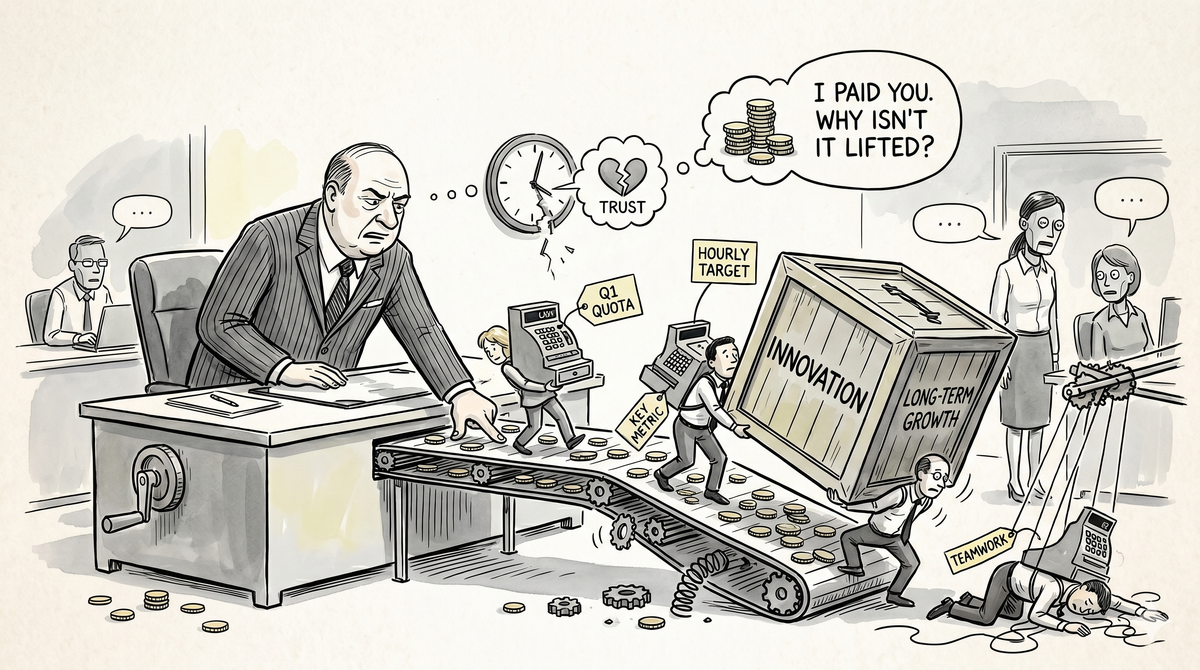
Several years ago, I worked with a CEO who had a very binary view of people – they were either "all in" or they needed to be gone. So much so that when people gave notice the CEO had them exit that same day. That policy wasn't a "day one" invention, but like The Joker in Batman, it has a very specific villain origin story.
Like many companies, we had a cohort of more junior employees for whom this was their first job. After two or three years, they thought about leadership roles, or different industry experience, or starting their own business. It's the natural rhythm of any larger organization. As that cohort hit those anniversaries, we saw elevated turnover. All were generally expected, but it happened in waves, which put stress on the team and delayed projects in the interim until someone new filled that role.
It made the CEO feel...things. This binary view of people was catalyzed by a two-minute elevator ride. Someone gave their two weeks' notice, and they happened to be in that 3x3 car with the employee and four of the person's coworkers. The soon-to-exit young lad received congratulations from his four coworkers, and he expressed excitement about his new role, which came with a promotion. As the doors opened, the CEO – likely modeling one of the darker Pantone purples on their face – called the departing employee's manager and said: "Walk him out now!" And after that day, "being walked out" was the policy. Why? Because "I don't want anyone happy about leaving here."
The outgrowth of this policy was easily predictable: Employees saw what happened and no longer gave two weeks' notice. They would "quiet quit" until they were ready to depart and drop their badge on their manager's desk. Teams were often left in a difficult position when there was no knowledge transfer and no project handoffs. The disarray rippled through the company, delaying product launches and impacting customers. Word spread externally as well: candidates would get to a certain point in the process and decline after hearing about the "100% committment or become an unperson" mentality from former or current employees.
A curious shadow process on exits took shape. Managers would surreptitiously tell their teams that, should they consider leaving, they should tell their managers verbally and that the managers would keep it from HR (and, by extension, the CEO), giving the employee a graceful exit and the team a real transition. For years, the "pinky-swear notice" was the norm.
This also triggered changes in the culture of the company. People saw working there as a very specific transaction: I give you time, you give me money. And: I can't trust you since you don't value me. Where, before, when the CEO would talk about "one team," people took that to heart. Now it was a punchline: "one team...unless you have any ambition." The enthusiasm for the company's success, along with the desire to put in extra effort for the good of a project, began to slip away.
That vanished emotional attachment to the work or the team affected performance as well – projects slipped, tensions flared between groups, customer NPS dipped. It became an exemplar of the pitfalls of "transactional leadership."
There are variations on what "transactional leadership" is, but this one from The Decision Lab is a good summary.
Often applied in fast-paced or results-driven environments, transactional leadership is thought to be effective for achieving short-term objectives through accountability and motivation. However, this approach is considered outdated by some critics, who favor a more well-rounded, transformational leadership style focused on authentic connection—which transactional relationships often lack.
―The Decision Lab: Transactional Leadership
This idea of "authentic connection" might seem, well, kind of woo. The kind of leadership behavior advice that belongs in the same dusty bin as trust falls. But peer-reviewed research and countless historical examples show that teams where that authentic connection exists are the ones that thrive. Those organizations have three key advantages over transactional ones:
- Shared Purpose: We see this in sports all the time, where the "underdog" team performs far above expectations. Team members who deeply value one another and care about the team's success over their own gratification can do seemingly impossible things.
- Resilience: Authentic connections create a kind of invisible support system that helps people through adversity... something every single company faces. In the military, this is called "unit cohesion," and research shows it is directly linked to lower rates of post-traumatic stress and the ability to reset after difficult experiences.
- Trust and psychological safety: Being able to trust that your boss cares about you beyond the one thing you're doing right now and that your peers care about you is critical in successful organizations. Safety creates a place where people communicate openly, acknowledge mistakes without fear of reprisal or judgment, and adapt faster to changing situations. It's also a place where leaders are transparent and talk about reality, the good and the bad.
Trust and psychological safety are perhaps the most critical elements in successful companies. Harvard Business School professor Frances Frei has researched this extensively, in part by embedding in large organizations. This example is one of many:
“[W]hen Google spent years trying to rigorously explain differences in performance across its own highly skilled teams—a project they code-named 'Aristotle'—the company concluded that psychological safety explained 'everything.'”
― Frances Frei, Move Fast and Fix Things: The Trusted Leader's Guide to Solving Hard Problems
If trust and psychological safety are the common traits in high-performing teams, transactional leadership is the antithesis of that approach. It is quid pro quo: There's a number to hit this quarter; hit it, you get this money. There are support calls in the queue; clear them and go home early. It's entirely about short-term thinking, short-term outcomes, and short-term teams. When people see that you only care about what they can do for you in the moment, they respond in kind. They don't think about how to build on the tactics that drove the current quarter's success for the months and years ahead; they don't look for patterns in support calls to fix root causes.
Some may read this and think that organizations run by leaders who demonstrate authentic connection and build safety don't have metrics. Quite the opposite. Metrics give the team a rallying point and shared goals. And a team that runs on high trust and deep purpose absolutely crushes its metrics.
So how do you know if your organization's leadership is authentic or transactional? Here's a handy chart:
| Situation | Transactional | Authentic |
|---|---|---|
| A target gets missed | Who's blamed? | What did we learn? |
| This is a risky idea | What's my risk? | What would we need to do it? |
| Employee struggles | Target at risk? | What's going on with them? |
| The quarter is won | On to the next one | What did we build that lasts? |
| Mistake is made | Documented | Discussed / blameless retro |
Connection to the work and the people around you matters a great deal when times are tough or when problems are ambiguous. Good leadership isn't the product of a title, the hierarchy, or the exchange of money for time. It's the ability to create that feeling of safety and purpose. When that happens, people take risks and they innovate. They solve problems faster and recover from missteps more easily. They feel a deep connection to the team's success, which allows them to do incredible, unexpected things.
If you're a leader of any size team or company, you have to face a few universal truths: People are going to leave you for a new company they are more excited about than their current role. They will sometimes screw up. They'll miss some deadlines or targets. It's tempting to look at that and put in the incentives – positive and negative – to deal with "right now." It can work but it is not long-lived.
As Google's Project Aristotle showed, it is that authentic connection between leaders and teams that creates trust and produces high-performing teams. Trust compounds; transactions don't. Trust is the thing that allows organizations to come through tough times. Trust is what gives someone the agency to say, "There's a better way to do this." Business-as-sport is often a popular frame. So in that vein... If you want to win today's game, focus on transactions. You want to win a championship? Focus on trust.

Member discussion: